Business Development
(224) 213-5119
General Information
(513) 776-1078


- By Haley
- October 27, 2026
Table of Contents
Key Highlights
- Temporary labor in warehouses faces real warehouse safety hazards from forklifts, loading docks, and repetitive lifting.
- Employer responsibility is shared, with host employers and staffing agencies both playing a role in worker safety.
- OSHA citations often follow training gaps, weak safety protocols, or poor hazard control in general industry settings.
- Safety training before day one helps warehouse workers avoid preventable injuries and confusion.
- Strong safety records support supply chain management, steadier operations, and better customer satisfaction.
- Tracking near-misses and injury trends helps facilities improve safety performance over time.
Introduction
Warehouse operations move fast, and that speed can raise serious safety concerns for temporary workers. In a busy supply chain, new hires may enter unfamiliar warehouse environments filled with industrial trucks, loading dock traffic, and constant order fulfillment pressure. So who is responsible for temporary worker safety? The short answer is both the warehouse and the staffing agency. Still, the host employer usually controls the daily worksite, which makes clear training, supervision, and hazard prevention essential from the first shift.
Understanding Temporary Worker Safety in Warehouses
Warehouse temp labor is common because facilities need flexibility during demand swings, seasonal peaks, and changing customer orders. These workers support core warehouse operations, but they often enter fast-moving warehouse environments without deep site knowledge. That can raise the risk of warehouse injuries if safety protocols are weak or rushed.
At the same time, temporary status does not reduce the need for a safe environment. It increases the need for clear direction. To understand responsibility, it helps to define the role of temp labor first and then look at the key risks they face.
Defining Warehouse Temp Labor and Its Role
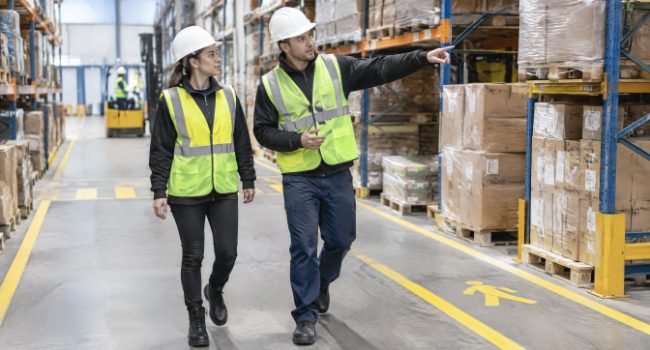
Warehouse temp labor refers to workers placed for short-term or flexible assignments in warehouse employment. They may help with picking, packing, shipping, receiving, and order processing. In many facilities, they support supply chain operations during peak periods, staffing gaps, or expansion into new markets.
You will often see these workers handling customer orders, moving goods through storage space, or supporting inventory management systems. Because warehouse operators rely on them to keep work moving, temps are not separate from the business. They are part of daily execution.
That is why a strong warehouse safety record matters so much for staffing agencies. A poor record can signal unsafe placements, training gaps, and weak oversight. A strong one shows clients that the agency values worker safety, supports compliance, and helps protect both people and operations.
Key Risks Faced by Temporary Workers
Temporary workers often face the same potential hazards as permanent staff, but with less familiarity with the site. That matters in warehouse environments where one missed step can lead to serious warehouse injuries. New workers may not yet know traffic patterns, blind spots, or emergency procedures.
The most common accidents that affect a warehouse’s safety record usually involve equipment, falls, and strain. Key risks include:
- Forklift accidents, including tip-overs and pedestrian strikes
- Loading dock incidents involving vehicle movement or falls
- Slips, trips, and falls from wet or uneven surfaces
- Musculoskeletal disorders from lifting, bending, and repetitive motion
For a temp worker, these dangers can appear quickly. If onboarding is rushed or safety protocols stay on paper instead of in practice, the odds of injury rise. That is why day-one training and close supervision matter so much.
The Importance of a Strong Warehouse Safety Record
A strong safety record shows more than low incident rates. It reflects reliable safety performance, better supervision, and stronger daily habits across warehouse facilities. In a sector where warehouse safety statistics remain worse than the industry average, a good record helps you spot whether a site is managing risk well.
It also affects the broader supply chain. Injuries can lead to worker absences, disruption, and slower service. When operations stay safer, customer satisfaction is easier to protect. That makes safety more than a compliance issue. It becomes a business measure worth tracking closely.
What a Good Warehouse Safety Record Means
A good safety record means a warehouse controls risk consistently and keeps warehouse injury rates below troubling levels. It is measured through lagging results, like recordable injuries, and leading indicators, like near-misses, inspections, and training completion. In simple terms, fewer incidents alone are not enough. You also need proof that prevention is active.
The Bureau of Labor Statistics reported 4.8 injury cases per 100 full-time equivalent workers in U.S. warehouses in 2024, compared with 2.3 across all private industry. That baseline helps facilities compare their safety performance against the broader market.
Measure | What It Shows |
| Injury rate per 100 FTEs | A core safety KPI for comparing warehouse injury rates |
| Near-miss volume | Whether hazards are being caught before harm occurs |
| OSHA citations | Whether safety standards and procedures are being followed |
| Training completion | Whether workers received required safety training |
| Lost workdays | The operational impact of injuries and worker absences |
A strong safety record is measured by trends, not one lucky quarter.
How Warehouse Accidents Affect Reputation and Operations
Warehouse accidents affect more than the injured worker. They create safety concerns across the floor, slow output, and disrupt staffing. A major incident can exceed $200,000 in total impact once you include investigation time, retraining, and productivity loss. Even smaller events can create delays in order fulfillment and inventory management.
For warehouse operators, that can damage customer experience. Injuries may trigger worker absences, equipment downtime, or process changes that slow customer orders. In tight logistics operations, even short disruptions can ripple across service levels.
This is especially important for third-party logistics providers. Their value depends on reliable logistics services, steady throughput, and trust. If safety records weaken, clients may question service quality, operational discipline, and the provider’s ability to protect both workers and supply chain performance.
Legal Responsibility for Temporary Worker Safety
Legal responsibility for temporary worker safety is shared, but it is not vague. Under OSHA and general industry rules, both the host employer and the staffing agency have employer responsibilities. The warehouse controls the site, equipment, pace, and many daily safety standards.
The staffing agency still has a duty to place workers carefully and support safe assignments. In practice, that means both sides must communicate about hazards, training, and supervision. The next two sections explain how OSHA frames employer responsibility and where shared liability can arise.

Employer Responsibilities Under OSHA
OSHA safety regulations shape warehouse safety records by setting the baseline for acceptable conditions. Warehouse operations generally fall under OSHA’s 1910 General Industry standard. That includes equipment use, walking-working surfaces, hazard communication, lockout/tagout, and powered industrial trucks. When these rules are ignored, injury risk rises and OSHA citations become more likely.
For the host employer, employer responsibility starts with the actual workplace. If you control the floor, you must control the hazards. That includes enforcing safety protocols, maintaining clear aisles, training forklift operators, and making sure emergency procedures are understood.
A strong safety record usually reflects this kind of daily discipline. A weak one often points to gaps in training, inconsistent enforcement, or outdated procedures. OSHA regulations matter because they turn safety from a loose goal into a documented standard that can be measured and enforced.
Staffing Agency Roles and Shared Liability
A staffing agency cannot treat safety as someone else’s problem. Shared liability exists because the agency sends workers into the warehouse and should understand the job conditions. If a facility has repeated warehouse injury rates, unclear duties, or weak onboarding, that should raise concern before placement.
Temp labor agencies help support compliance by checking the worksite, reviewing the role, and reinforcing worker expectations. Practices like introductory safety assessments and ongoing check-ins help reduce blind spots.
- Review the job site and common hazards before placement
- Confirm that safety training will happen before the first shift
- Check whether PPE, such as hard hats or vests, is required by zone
- Follow up regularly on incidents, near-misses, and safety KPI trends
These steps do not remove the host employer’s duty, but they do show how a staffing agency helps protect worker safety.
Third-Party Logistics Providers and Warehouse Contract Labor Safety
Third-party logistics providers often depend on warehouse contract labor to meet volume swings, serve more sales channels, and keep supply chain management moving. That creates flexibility, but it also adds pressure to maintain consistent safety practices across shifts, teams, and warehouse space.
Because 3PL companies sell reliability, safety is part of service quality. Injuries, compliance failures, and preventable downtime can hurt logistics services and client trust. To see how that works, it helps to look at the safety support 3PL companies provide and the compliance issues contract labor can create.
How 3PL Companies Support Warehouse Safety Programs
3PL companies support safety programs because their business depends on stable logistics operations. A poor safety record can lead to delays, worker turnover, and client concern. Stronger records support customer satisfaction, smoother order fulfillment, and more confidence in the provider’s experienced team.
Many 3PL companies make safety investments in training, monitoring, and process control. Some organizations using continuous camera-based monitoring and data-driven coaching have reported major injury reductions and even eliminated OSHA citations within a year. That kind of visibility helps spot warehouse safety hazards earlier.
For third-party logistics providers, the payoff is operational. Better safety can reduce disruption across distribution center activities, protect customer orders, and strengthen service performance. In a competitive market, that can support customer retention and make it easier to win business in new markets.
Compliance Issues for Warehouse Contract Labor
Contract labor can create compliance challenges when workers move between sites, roles, and supervisors. Safety concerns often grow when expectations are not site-specific. A worker may know general warehouse rules but still not understand a facility’s dock traffic, storage space limits, or emergency process.
That is why resources for maintaining and tracking safety records matter. Warehouses need systems that connect training, inspections, near-misses, and incidents so trends become visible before they turn into injuries. Practical tools include incident reporting, pre-shift logs, walkthroughs, and camera-based monitoring.
- Warehouse management system records tied to operations and training
- Incident reporting systems for hazards, injuries, and near-misses
- Regular hazard assessments and equipment inspection records
- Benchmark data from warehouse safety statistics and internal safety KPI reports
Good compliance is not just paperwork. It is proof that contract labor is being managed safely on the floor.
Key Elements of an Effective Warehouse Safety Program
An effective warehouse safety program is built on simple best practices that people actually follow. Written rules matter, but training, inspections, and enforcement matter more. In fast warehouse operations, the goal is to reduce confusion before it turns into injury.
Strong programs also support operational efficiency. When hazards are identified early and workers know what is expected, you get fewer disruptions and more consistent performance. The sections below cover two core elements: safety training for temporary workers and ongoing risk assessment supported by clear reporting and warehouse management system data.
Safety Training for Temporary and Contract Workers
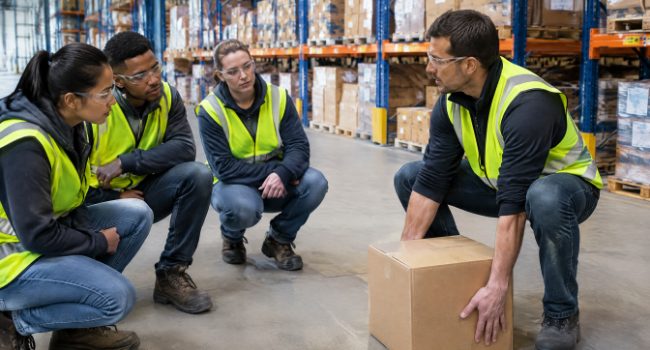
Safety training is one of the clearest ways to reduce incident rates. Temporary and contract warehouse workers should receive orientation before the first shift, not after a problem. Effective programs stress day-one instruction on hazard zones, PPE requirements, reporting procedures, and facility-specific risks.
Companies prevent accidents when employee training is practical and repeated. Refresher courses and hands-on practice can reduce incidents by more than 60 percent. That matters in busy sites where pace and turnover can otherwise weaken habits.
- Day-one safety training before any task begins
- Clear instruction on forklifts, loading dock areas, and walkways
- PPE rules by zone, including high-visibility gear or hard hats where required
- Buddy support or close supervisor check-ins during the first week
- Refresher training after process changes or incidents
Good training protects workers and strengthens the warehouse’s safety record at the same time.
Ongoing Risk Assessment and Hazard Identification
Training alone is not enough. Warehouses track and improve safety records effectively when they keep looking for risk after onboarding. That means regular risk assessment, walkthroughs, equipment checks, and review of near-misses. A safe environment comes from repetition, not one-time attention.
Hazard identification should focus on the potential hazards most likely to cause harm in warehouse environments. Those include spills, blocked aisles, unsafe lifting, pedestrian exposure, and vehicle behavior. Near-miss tracking is especially important because loading dock injuries may be preceded by hundreds of warning events.
When you review these signals often, patterns appear. That helps leaders coach specific behaviors, update procedures, and target safety investments where they can lower risk fastest. In short, better tracking leads to better action.
Common Warehouse Accidents and How to Prevent Them
Warehouse accidents often follow familiar patterns. Industrial trucks, slips, falls, and overexertion account for many of the incidents that drive warehouse injury rates upward. In a busy distribution center, small mistakes can turn serious quickly.
The good news is that many of these events are preventable. Strong safety protocols, practical training, and consistent monitoring can reduce exposure before injuries happen. The next sections break down the most frequent injuries in U.S. warehouses and the proactive steps companies use to lower incident rates.
Most Frequent Injuries in US Warehouses
In the United States, warehouse injury rates remain high. Bureau of Labor Statistics data shows 4.8 injury cases per 100 full-time equivalent workers in 2024, compared with an all-industry average of 2.3. Warehouse injuries have also climbed sharply over time, while fatal warehouse injuries remain a serious concern across transportation and warehousing.
The most common incidents affecting safety records include the following:
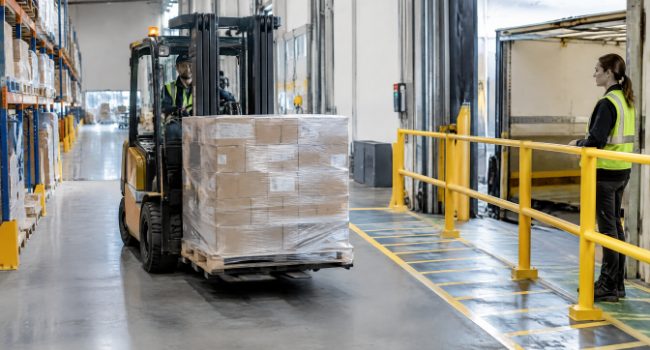
- Forklift accidents, with tens of thousands of injuries annually
- Loading dock incidents, which account for 25 percent of warehouse accidents
- Slips, trips, and falls, making up 27 percent of non-fatal warehouse injuries
- Musculoskeletal disorders, including back pain from lifting and repetitive motion
- Falls from ladders or elevated platforms linked to fatal warehouse injuries
These statistics show why prevention must stay a top priority. Warehouses are not dealing with rare events. They are managing recurring, well-known risks.
Proactive Steps to Prevent Workplace Incidents
Companies protect their safety record by preventing incidents before they become recordable cases. Several practical methods help: training, refresher coaching, hazard monitoring, pre-shift inspections, and strong site rules. These actions help reduce incident rates by addressing unsafe behavior early.
Forklift safety deserves special attention. Industry research suggests that 70 percent of forklift accidents could be prevented with proper training and monitoring. Since the National Safety Council also reports forklift deaths each year, this is one of the clearest areas for focused action.
Workplace safety improves when leaders combine written safety protocols with visible enforcement. Clean aisles, clear pedestrian paths, dock controls, lifting support, and fast spill response all matter. The strongest programs do not wait for injuries to reveal what was already dangerous.
Best Practices for Tracking and Improving Warehouse Safety Records
Tracking safety well means moving beyond annual injury totals. Incident reporting systems, near-miss reviews, and practical key performance indicators help you see what is changing on the floor right now. That gives managers a chance to act before a hazard becomes a claim.
Improvement also depends on comparison. Internal trends matter, but so do warehouse safety statistics and outside safety standards. The following sections explain how incident reporting supports continuous improvement and how benchmarking can show whether your safety performance is truly competitive.

Using Incident Reporting Systems for Continuous Improvement
Incident reporting systems help warehouses track and improve safety records by capturing more than injuries alone. They should include near-misses, unsafe conditions, PPE failures, equipment issues, and blocked warehouse space. When workers can report concerns easily, leadership gets a clearer picture of daily risk.
The best systems support a practical safety KPI approach. You can track injury rates, lost workdays, inspection completion, refresher training, and repeat hazards by area. This turns scattered events into patterns that can be managed.
Most important, reporting must lead to action. If teams flag loading dock problems, spills, or unsafe traffic flow and nothing changes, trust disappears. Continuous improvement happens when safety concerns are reviewed quickly, assigned clearly, and corrected before the same issue returns again.
Benchmarking Safety Performance in the US Logistics Sector
Benchmarking compares your safety performance with the wider logistics sector so you can judge whether progress is real. A warehouse may improve from last year but still perform poorly against the industry average. That is why outside reference points matter.
Useful U.S. benchmarks are available. Warehouses recorded 4.8 injuries per 100 FTEs in 2024, while the all-industry average was 2.3. The transportation and warehousing sector also recorded 930 fatalities in 2023, with a fatal injury rate of 12.9 per 100,000 FTE workers. Those numbers show the level of risk tied to warehouse employment.
Benchmark Area | U.S. Reference Point |
| Warehouse injury rate | 4.8 cases per 100 FTEs |
| All-industry average | 2.3 cases per 100 workers |
| Sector fatalities | 930 in transportation and warehousing in 2023 |
| Fatal injury rate | 12.9 per 100,000 FTE workers |
| Useful resources | Internal dashboards, safety KPI reports, incident logs, BLS benchmark data |
Benchmarking works best when used with regular internal review.
Conclusion
Temporary worker safety in a warehouse is a shared responsibility that involves employers, staffing agencies, and third-party logistics providers. By understanding the key risks and implementing an effective safety program, all parties can contribute to a safer work environment for temporary staff. Regular training, proactive risk assessments, and continuous improvement efforts are essential in preventing workplace accidents and promoting a strong safety record. Remember, maintaining a robust safety culture not only safeguards employees but also enhances the reputation and operational efficiency of the organization.
Need safety-focused warehouse labor for your facility? Explore CQS warehouse labor solutions or contact our team to discuss your staffing needs.
Frequently Asked Questions
Who is ultimately liable for temporary worker safety incidents?
Liability is often shared between the staffing agency and warehouse operators, but OSHA focuses heavily on who controls the worksite hazards. If a temporary worker is injured because of unsafe floor conditions, poor training, or weak supervision, the host employer often carries the main responsibility.
How do warehouse temp labor agencies ensure compliance with safety regulations?
A temp labor agency supports compliance by reviewing job conditions, discussing safety regulations with the client, confirming training plans, and checking in after placement. These steps help protect worker safety and make sure warehouse safety expectations are clear before and during the assignment.
What resources help warehouses maintain and track safety records?
Useful resources include a warehouse management system, incident reporting tools, pre-shift inspection logs, hazard assessments, and dashboards that track safety KPI data. Together, these key performance indicators help warehouses monitor safety records, identify repeat issues, and improve prevention efforts over time.

Haley serves as the Marketing Manager for Complete Quality Solutions. She joined CQS in 2023 with her prior experience gained with GXO and XPO Logistics.